
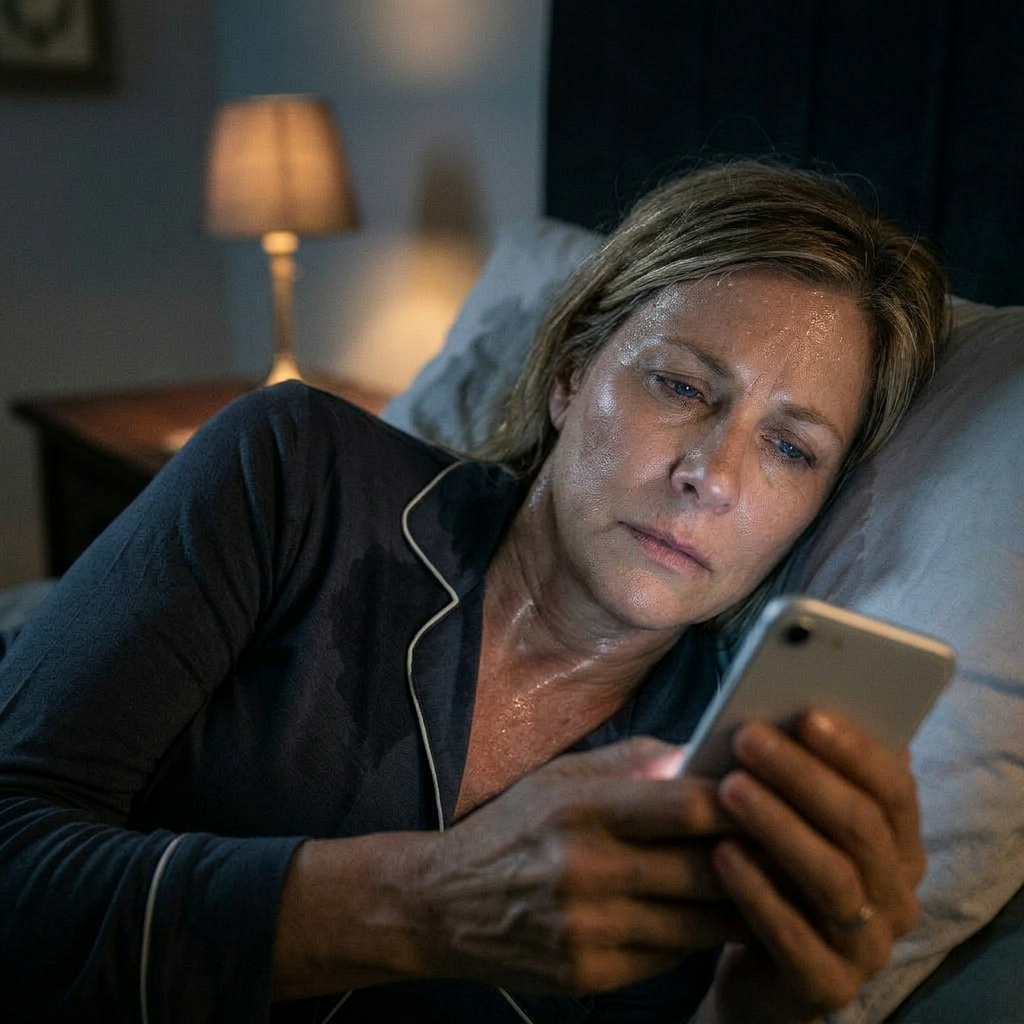

If your sleep fell apart, your memory got foggy, and your mood started swinging in ways you don't recognize, you're probably carrying a list in your head of things that changed in the past few years.
That list is longer than it should be.
And If You've Been Told to "Just Sleep Better and Reduce Your Stress," You Already Know How Useless That Advice Is
They tell you to exercise more, cut sugar, and get quality sleep. As if you're not already doing everything you can while your body does whatever it wants at 3AM.
How are you supposed to "get better sleep" when the thing wrecking your sleep is the thing your doctor won't address?

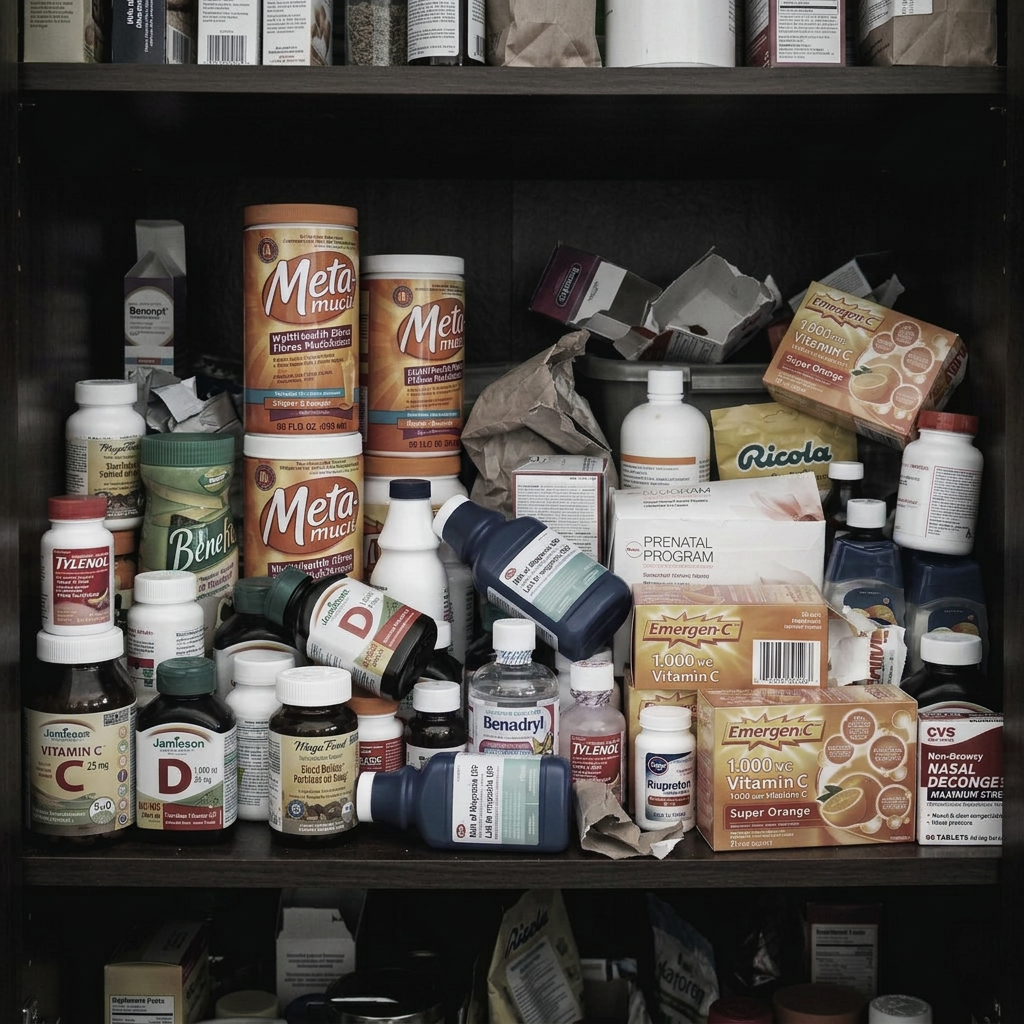
"I'm so sick of reading about how the answer to everything is exercise, and cutting out the foods and drinks that bring me a modicum of joy in my life. I've done all of it. I'm still waking up seven times a night soaked through."
From a real r/Menopause thread, 161 upvotes
If that sounds familiar, you're not losing your mind and you're not alone. You're stuck in the impossible loop where the recommended cure requires the exact thing the condition destroys.
There's One Hormonal Shift Behind All of It
The sleep disruption, the brain fog, the rage, the weight, the 3AM wake-ups, the puffy mornings. They trace back to a single change that happens inside your body after 40, and it has to do with what happens to your stress hormone when the one thing that used to regulate it starts to decline.
Here's What's Happening Inside Your Body After 40, and Why It's Hitting You at Night:
Reason #1
Your Brain Ran on Estrogen for Decades. Now It's Running Without It.

Estrogen doesn't just regulate your cycle. It runs your brain. It supports the neurons that handle memory, the serotonin that regulates your mood, and the sleep architecture that lets you recover overnight. When estrogen starts declining, your brain loses the support system it relied on for decades, and it has to figure out how to operate without it.
Research led by Lisa Mosconi at Weill Cornell has found that the brain's metabolism and connectivity patterns reorganize during this transition. That reorganization is real, it's measurable, and it's happening while you're standing in the grocery aisle trying to remember what you came for, or losing a word mid-sentence that you've used your entire life.
The research suggests these cognitive changes are typically reversible once sleep and cortisol stabilize. But that part doesn't make it to most doctor's appointments.
Possibly. Your brain has a nightly cleanup system called the glymphatic system that works best during deep sleep. It clears out metabolic waste, including proteins like tau and beta-amyloid. When you keep waking up drenched, that cleanup gets interrupted. Over time, that leaves you foggy and scattered. These symptoms are common during this transition, and they could potentially contribute to longer-term risk if sleep stays disrupted.
Earlier than most doctors acknowledge. Perimenopause can begin in the early 30s. Thousands of women describe the same pattern: they went to their doctor at 35 or 38 with brain fog and night sweats, got told they were too young, and walked out with an SSRI prescription. 94% of women say they received zero education about this before it started.
Reason #2
Your Cortisol Lost Its Off Switch
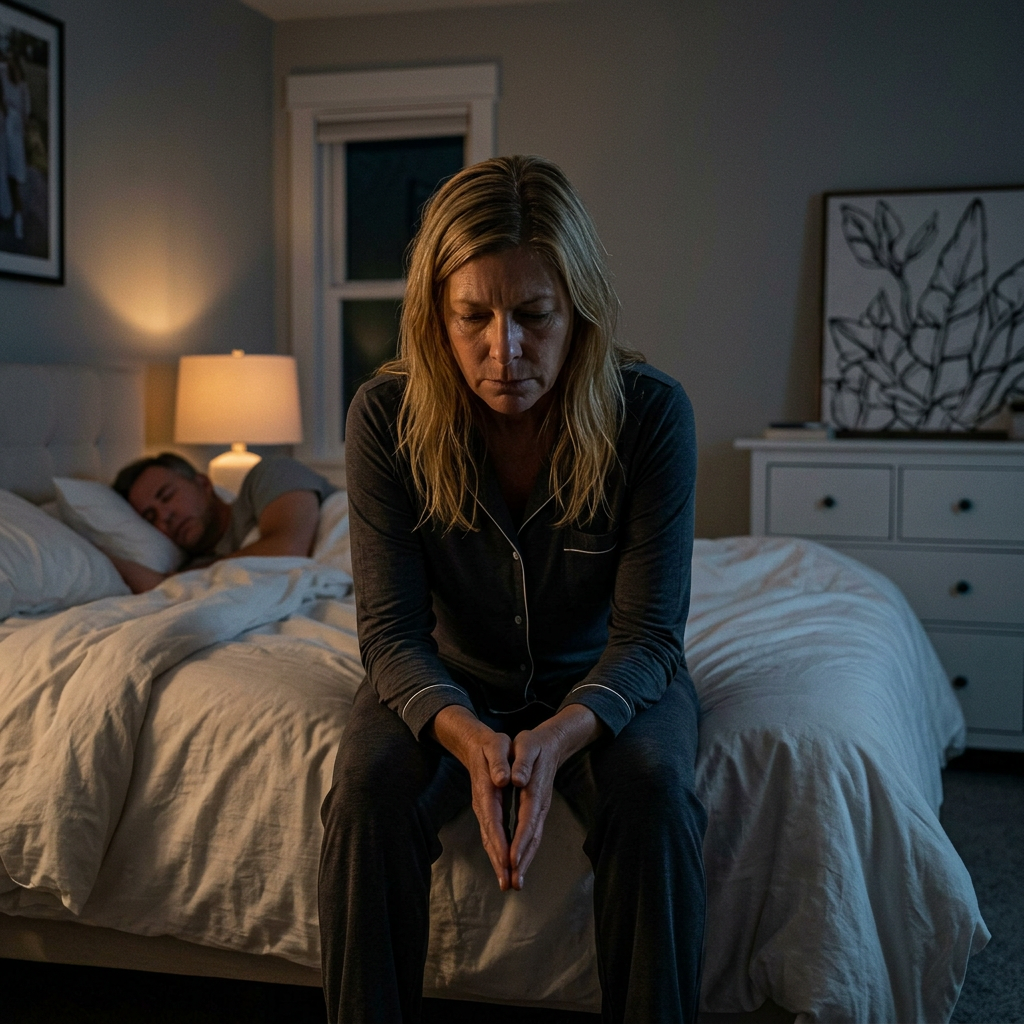
Cortisol is your stress hormone. For most of your life, estrogen helped regulate it through the HPA axis. When estrogen declines, those brakes disappear. Cortisol doesn't just rise because life is stressful. It rises because the hormone that kept it in check is gone.
Elevated cortisol at night disrupts your sleep, drives the temperature spikes, impairs your memory, promotes fat storage around the midsection, and makes your emotional responses more reactive — all from one hormone running unregulated.
Yes. Without estrogen pulling cortisol back to baseline, your nervous system stays in low-grade fight-or-flight even when you're lying in bed. The jaw clenching, the racing thoughts, the heart pounding at 2AM. It's not anxiety. It's cortisol running without brakes.
Reason #3
That's Why You Wake Up Drenched at 3AM
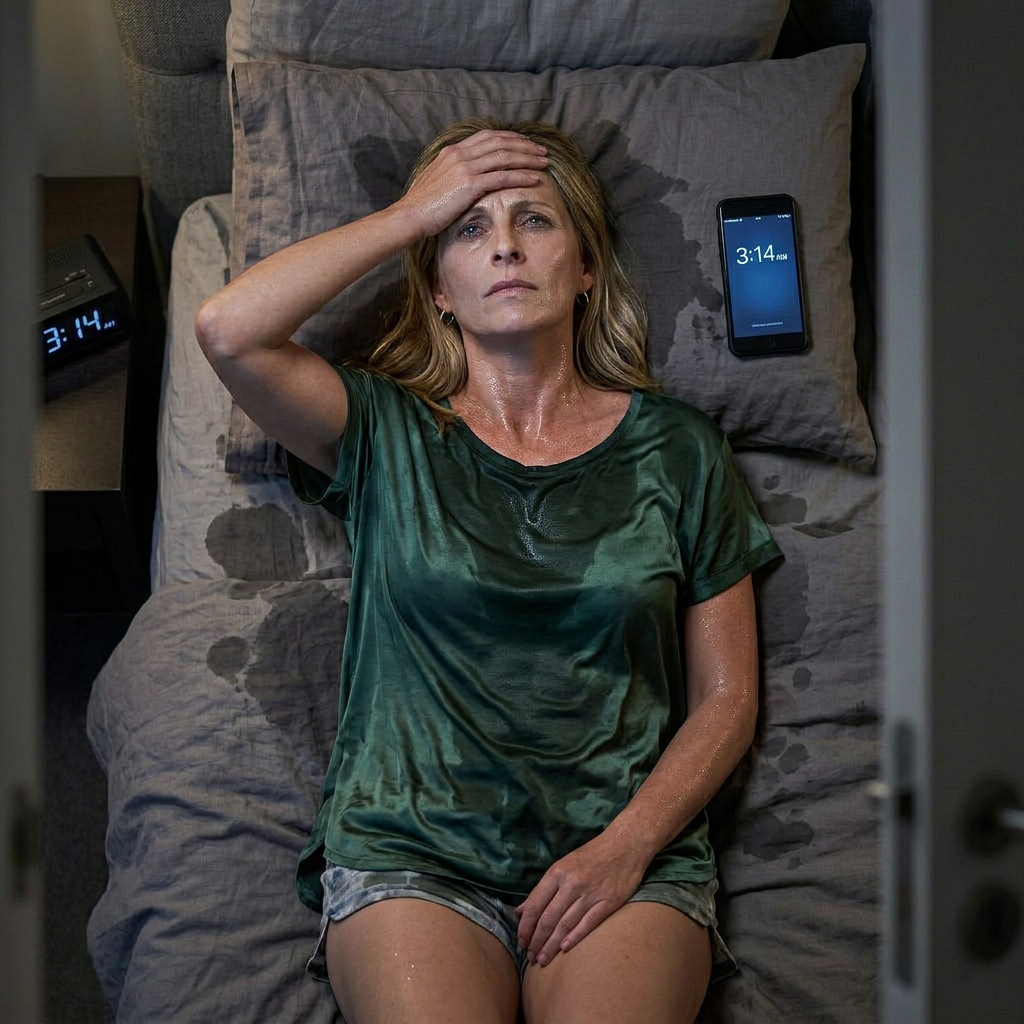
If you've been tracking when you wake up soaked, you've noticed it's the same window most nights. Around the three-hour mark after you fall asleep, your hypothalamus enters a vulnerable window between sleep cycles. If your cortisol is elevated, this is the moment it fires. Temperature spikes, heart rate jumps, you're drenched, then freezing by the time the air hits.
When you eat sugar in the evening, your blood glucose spikes and crashes while you sleep. That crash triggers an additional cortisol release on top of the elevated baseline you're already carrying. Two triggers converge at the same vulnerable point in your sleep cycle. That's why women on HRT who eat sugar before bed still get episodes.
Melatonin forces your brain offline at 10PM but does nothing about the cortisol spike at 3AM. You fall asleep fine and wake up drenched anyway. And the next morning you feel like cement because melatonin suppresses your natural wake signals. Sedation is not sleep.
Reason #4
The Brain Fog Isn't Early Dementia

You forget words that should come automatically. You read the same email three times. You blank on names of people you've known for months. And at 3AM, the thought that keeps surfacing is: what if this is the beginning of something permanent?
Elevated cortisol impairs the hippocampus, the part of your brain that handles short-term memory and word retrieval. Declining estrogen reduces serotonin and acetylcholine. Broken sleep means your brain can't complete its nightly recovery. Three inputs compromised at once.
When sleep improves and cortisol comes back toward baseline, the fog tends to lift.
A widely covered study found that night sweats were associated with adverse beta-amyloid profiles. But hot flashes appear to be a marker of inflammatory risk, not a confirmed direct cause. The research suggests that sleep quality during this window matters for long-term brain health. That's a reason to address cortisol and sleep now.
Reason #5
The Rage and the Weight Aren't Your Fault

You snapped at someone you love over something that wouldn't have registered five years ago, then sat with the guilt for the rest of the day. This cycle used to happen once a month. Now it's four times a week, and your doctor calls it anxiety.
Declining estrogen makes the amygdala more reactive. Your irritation threshold drops. Layer in sleep deprivation and you've got a nervous system on fumes with a hair-trigger response.
The weight is the same cascade from a different angle. Elevated cortisol promotes fat storage at the midsection. Declining estrogen redirects distribution from hips to stomach. Broken sleep wrecks leptin and ghrelin, which is why you crave carbs at 9:30PM.
No. This is a hormonal transition that every woman's body goes through. No amount of clean eating or meditation could have prevented it. Your body isn't malfunctioning because you made bad choices. It's doing what biology programmed it to do.
Reason #6
Why Your Supplement Drawer Didn't Fix It

Melatonin sedates you but doesn't touch the cortisol spike at 3AM. Magnesium calms the surface but misses the trigger. CBD, black cohosh, evening primrose — they each address a piece, at doses too low to do much, and none of them target the central problem.
One ingredient — KSM-66 Ashwagandha at 600mg, the dose from the clinical research — has been shown to support healthy cortisol response. That's the anchor of BIGYAWN, a raspberry lemonade drink mix designed for the nighttime cortisol problem.
KSM-66 is a patented extract used in over 24 published clinical studies at 600mg. Most supplements use generic extracts at 100-150mg. That's enough to put the name on the label, not enough to do what the studies showed.
Yes. Every ingredient is non-hormonal and works through pathways separate from HRT. Many women on HRT still get cortisol-driven 3AM episodes. This is designed to fill that gap.
Reason #7
What Women Over 40 Are Saying About It

"My shoulders aren't at my ears anymore. I didn't even realize how tense I was until it stopped. About a week in and I noticed I wasn't clenching through the day. My shoulders dropped. My breathing got deeper. I used to think that tension was just how my body worked. It wasn't."
Tracy M. Verified Customer
"This replaced my wine and my sleep is better than it's been in years. I was pouring a glass every night just to turn my brain off. I'm 4 months in now. No wine. Less bloated. Sleeping 7 hours straight most nights. I genuinely don't miss it."
Colleen V. Verified Customer
"I'm a nurse. 12-hour shifts. This is the only thing that helps me come down. By the time I get home I'm wired and exhausted at the same time. This calming drink is the first thing that helps me transition from work mode to sleep mode without feeling drugged the next morning."
Patricia L. Verified Customer
"Less brain fog. More energy. And my face looks different. I'm 46 and menopause hit me hard. The fog was the worst part because I couldn't trust my own brain anymore. After about two weeks the clarity started coming back. I'm less puffy in the mornings and I have more energy by 10am than I've had in over a year."
Michelle S. Verified Customer
"I'm 46 and my doctor kept telling me it was stress. Then she said anxiety, then she wanted to put me on antidepressants. I wasn't depressed, I was furious and no one would listen. 2 weeks on this drink and the fog started lifting. I could finally think again, sleep through the night again."
Amber T. Verified Customer
"I cried the first morning I woke up dry. You don't understand about night sweats, I'd been changing the sheets every single night for eight months. My husband thought I was being dramatic but I just sat there on the bed and sobbed because I finally felt normal again."
Angela B. Verified Customer
"I just wasn't ready for HRT yet. I know it helps a lot of women, and maybe I'll get there, but I wasn't ready to make that step when everything first started changing. BIGYAWN gave me that. It helped take the edge off at night, and little by little I started feeling more steady again."
Denise C. Verified Customer
That makes sense. That's why there's a 30-day guarantee. Try it for 30 nights. If you don't notice better sleep and fewer night sweats, you get your money back. 93% of women report improvement within the first two weeks.
✓ 30-day guarantee · ✓ Free shipping · ✓ No melatonin
Quick Answers to Your Most Important Questions:
Try it for 30 days. If you don't notice a difference, full refund. No hoops.
No. Zero melatonin. You wake up clear, not foggy.
Yes. Non-hormonal. Works alongside HRT.
Most feel calmer within the first hour. Sleep improves within 3-7 nights.
Raspberry lemonade. Mix with cold water or over ice.
Yes. Every batch. No proprietary blends, no hidden fillers.
Yes. Also free from dairy, soy, and artificial sweeteners.
Why Thousands of Women Have Made the Switch
My shoulders aren't at my ears anymore.
I didn't even realize how tense I was until it stopped. About a week in and I noticed I wasn't clenching through the day. My shoulders dropped. I used to think that tension was just how my body worked.
This replaced my wine and my sleep is better than it's been in years.
I was pouring a glass every night just to turn my brain off. I'm 4 months in. No wine. Less bloated. Sleeping 7 hours straight most nights.
I'm 46 and my doctor kept telling me it was stress.
Then anxiety, then antidepressants. I wasn't depressed, I was furious. 2 weeks on this drink and the fog started lifting. I could think again, sleep again.
I cried the first morning I woke up dry.
I'd been changing the sheets every single night for eight months. I sat there on the bed and sobbed because I finally felt normal again.
Less brain fog. More energy. And my face looks different.
I'm 46 and menopause hit me hard. After two weeks the clarity started coming back. Less puffy in the mornings. More energy by 10am than I've had in over a year.
I'm a nurse. 12-hour shifts. This is the only thing that helps me come down.
By the time I get home I'm wired and exhausted at the same time. This helps me transition from work mode to sleep mode without feeling drugged the next morning.
I just wasn't ready for HRT yet.
I wanted to start with something that felt gentler. This helped take the edge off at night, and little by little I started feeling more steady again.
30 Days to Find Out If It Works for You
Try BIGYAWN for 30 days. Most women feel the difference within the first week. If you don't notice better sleep, fewer night sweats, and less morning puffiness, contact us for a full refund.

Get Your BIGYAWN® Starter Bundle Now

You've spent the last however-many months handling this by yourself, on about four hours of sleep. This is one small thing, at the end of a long day, that might help you sleep through the night and wake up feeling like yourself again.
First-time buyers receive up to $120 off, free shipping, and a 30-day money-back guarantee.
FREE Shipping · 30-Day Guarantee · No Melatonin
Your night. Finally yours again.